Project
Seed.Potato.Pixel
Human–AI–Ant Interface
Project Overview
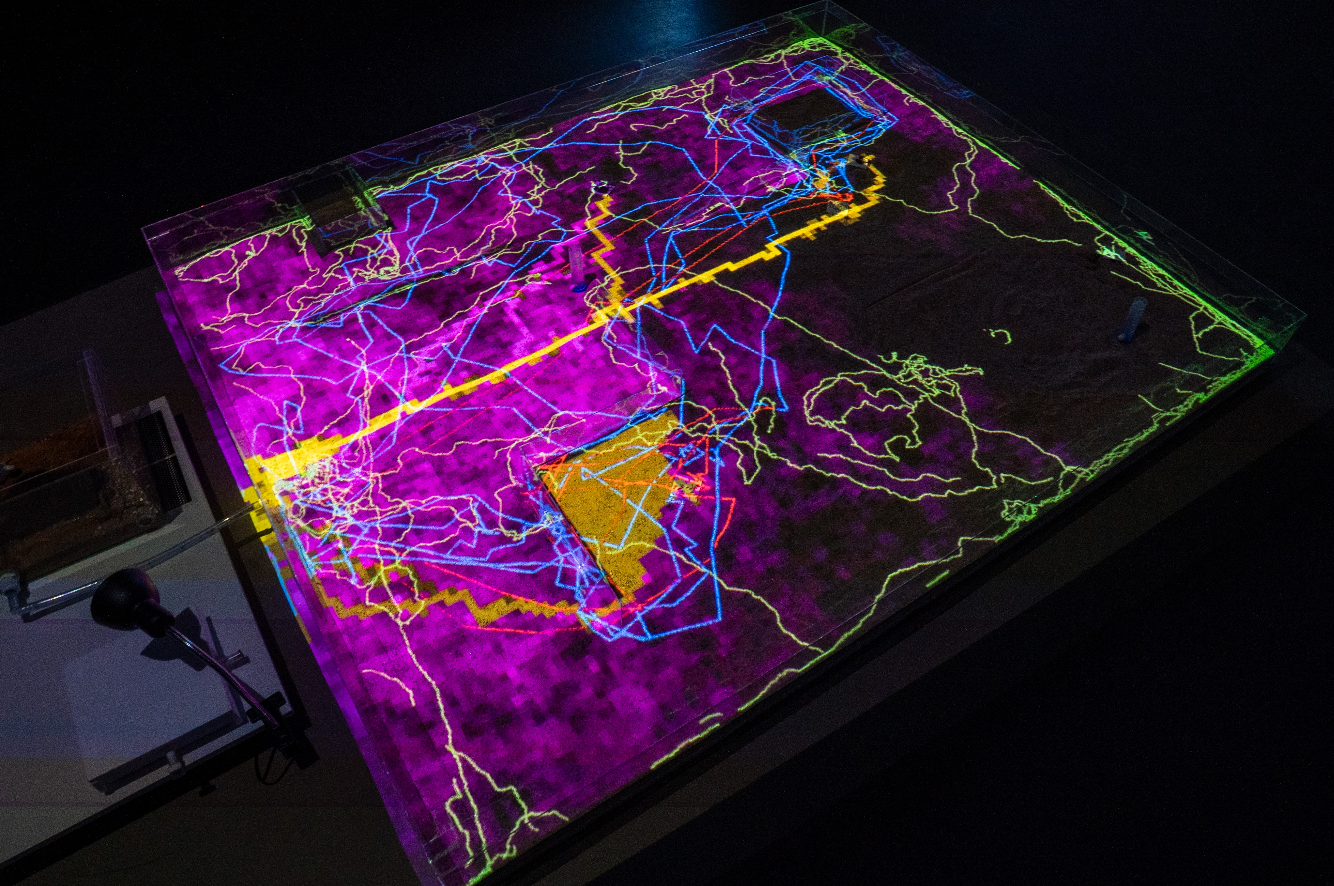
How do ants, humans, and algorithms find their way through a shared environment? Seed. Potato. Pixel. brings their walking paths together in an installation that combines living ants, embodied experiments, computer vision, and projected simulations. It grew out of the Interspecies Research Cluster, a collaboration between Alessandro Mac-Nelly, Mika Zoé Rosenberg, Lilli-Chiara Kurth, and Max Baraitser Smith at Design & Computation, UdK Berlin / TU Berlin.
The following sections trace the wider research behind the installation: from an imagined ant computer and early sensory experiments to the design of a shared arena and a comparison of three kinds of foraging. This is a condensed account of our full paper (Mac-Nelly et al., 2025).
From an ant computer to interspecies research
The project began with a speculative question: could a computer be powered by living ants? We abandoned that goal when its practical and ethical problems became clear. What remained was a more productive inquiry into how ants navigate, organise, and live, and how humans might learn with them. Ants, humans, and machines continued to shape the work, but the emphasis shifted from using biological intelligence to examining the relationships between these agents.
Our backgrounds in architecture, sound art, fine arts, programming, and computational linguistics led to a practice that combined reading, prototyping, observation, and care. We worked first with Lasius niger and later with Messor aegyptiacus. Feeding, maintaining habitats, and responding to the colonies’ behaviour became part of the research process. The paper’s manifesto and speculative ant fiction explored the same questions through writing: whose needs shape an experiment, and what might coexistence beyond human priorities look like?
Ecology, ethics, and the language of ants
Our theoretical starting point was that ants cannot be understood independently of their relationships and environments. Gordon (2023) describes collective behaviour as emerging through interactions rather than central command. Haraway (2016) offers a way to think about knowledge and responsibility through multispecies relations. These perspectives encouraged us to question models that reduce ants to fixed roles or predictable machines.
The terms we use also matter. Drawing on Sleigh (2001), we examined how representations of ants carry human histories of empire, hierarchy, and control. Words such as “queen”, “worker”, and “colony” can encourage misleading analogies with human society. The account of ant–human relationships by Ellison and Gotelli (2021) helped us frame an ethical ambition: seek encounters that benefit the ants, or at least avoid harming them. Whether our own arrangements achieved this remained an open question.
Zoo3: sharing sensations
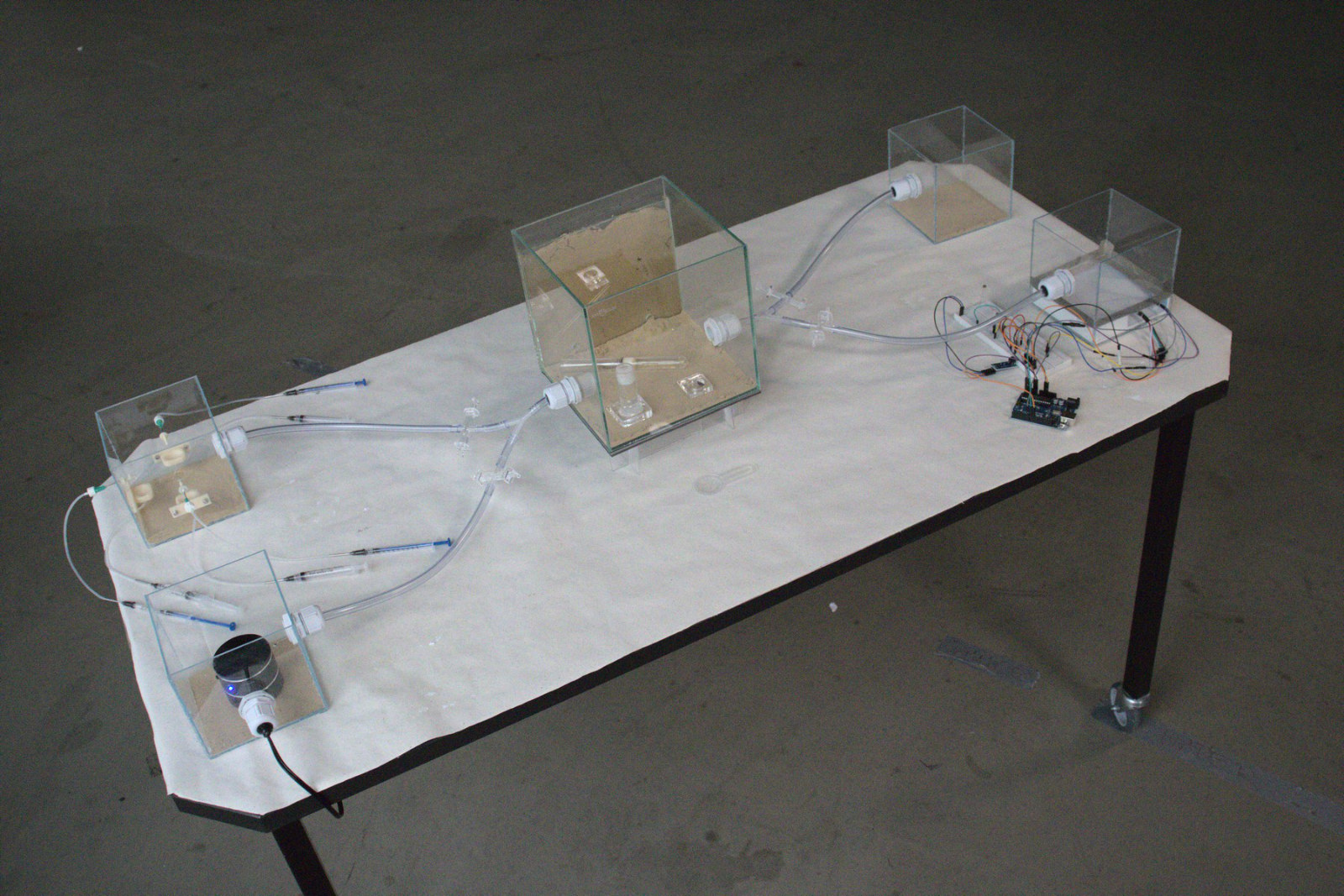
Zoo3 was our first installation with the Lasius niger colony. Four chambers connected to its nest introduced human sweat, low-frequency vibrations, light, and an empty control space. We initially approached the setup through encoding and decoding, inspired by Shannon’s (1948) communication model. Could a stimulus become a message that another species could interpret?
We did not establish such a communication system. Instead, the work became a speculative encounter between different sensory worlds. Keeling’s (2017) concept of shared arenas of sensation helped us describe this shift: contact does not necessarily require a shared symbolic language. Zoo3 made that question tangible, while leaving the ants’ interpretation of the stimuli unresolved.
Learning through embodied simulation
Simulation became a way to explore selected aspects of ant foraging through human bodies. A study comparing cooperative puzzle-solving in ants and humans provided a methodological reference for working across species and scales (Dreyer et al., 2025). Our own experiments focused on navigation, limited sensory information, and the experience of belonging to a distributed group.
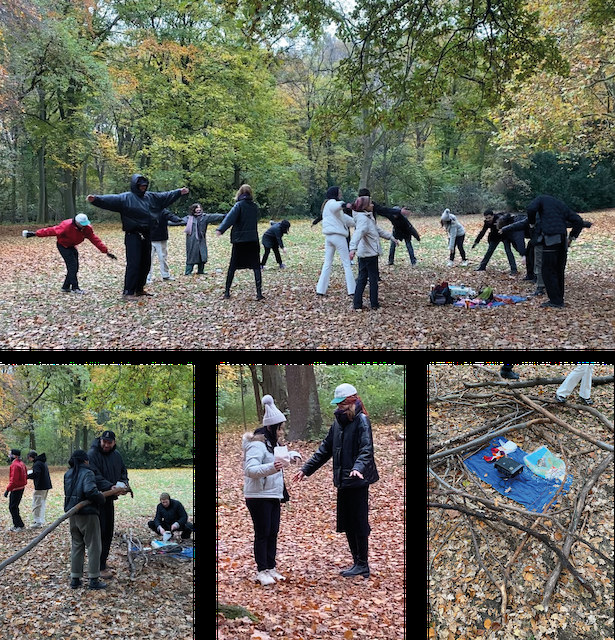
In autumn 2024, 24 participants joined a field experiment in Berlin’s Tiergarten. Each simulated ant consisted of a blindfolded participant and a sighted sensory mediator. Together they collected sticks, used a loudspeaker to locate the nest, and followed wood-chip trails standing in for pheromones. Participants described a growing sense of collectivity; encounters at the nest created moments of rest, exchange, and friendly competition. The exercise also exposed the limits of translation: wood chips do not evaporate like pheromones, and restricting human vision does not reproduce an ant’s sensory world.
Building and sensing the arena
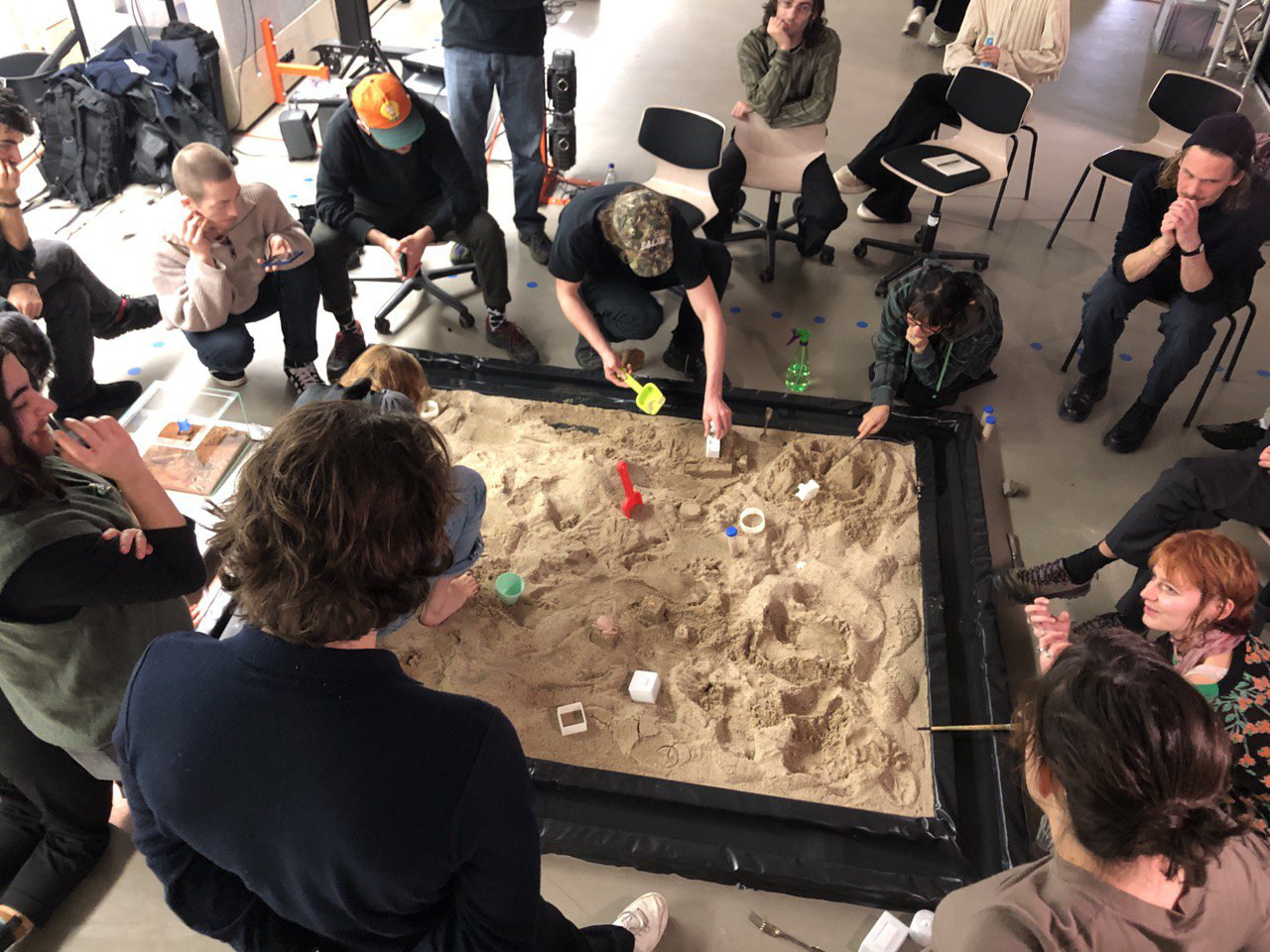
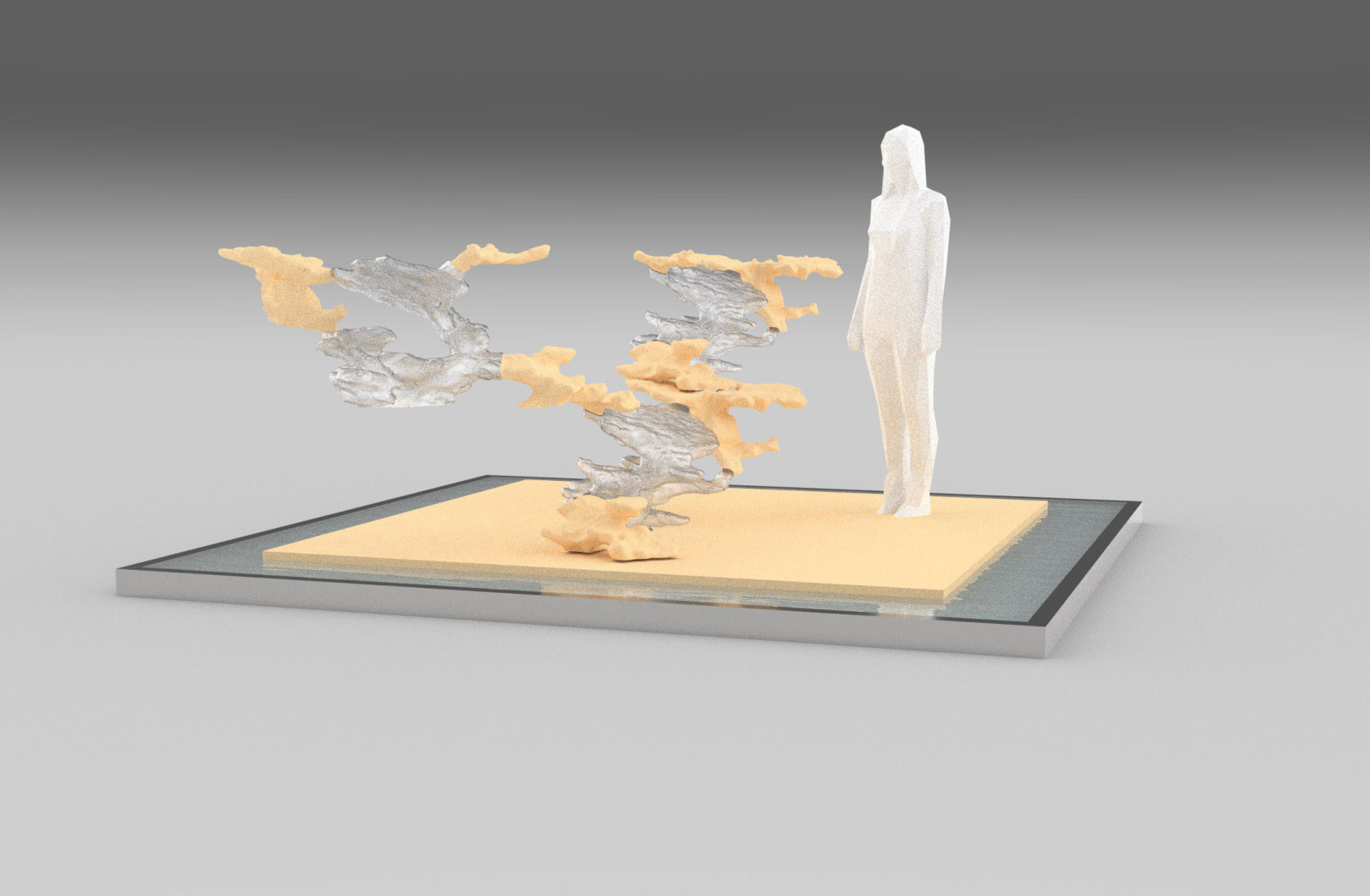
The habitat developed from small glass chambers into a 2 × 1.6 m sand-filled arena. Early workshops invited people to build sandcastles and structures for ants. We also explored a proposal based on 3D-scanned ant nests, informed by research linking foraging behaviour and nest architecture (O’Fallon et al., 2023). The final sandbox used plexiglass barriers after a surrounding water moat proved unsuitable. Habitat design became an iterative response to the ants and to the practical demands of observation.
Tracking began with simple drawing exercises: following an ant with a pencil and comparing human and ant paths from above. We then built a Python/OpenCV system that captured the sandbox once per second, detected small moving candidates through background subtraction, and projected their paths back onto the sand. Persistent detections were retained, while noise and implausible movements were filtered. Changing light, shadows, and the ants’ small image size remained constraints.
Observation also supported care. We counted dead ants weekly and later adapted the tracking system to monitor colony activity. The paper considers other monitoring techniques, including infrared entrance sensors (Noda et al., 2006). Our own counts and activity traces offered partial indicators rather than a complete measure of colony health.
Seed / Potato / Pixel: three foraging experiments
The installation brought three experiments into a shared visual frame. Each used a version of the same labyrinth, with corresponding food locations and obstacles. Their recorded paths could then be projected onto the sandbox to make different ways of navigating visible.
Seed — ants exploring a labyrinth
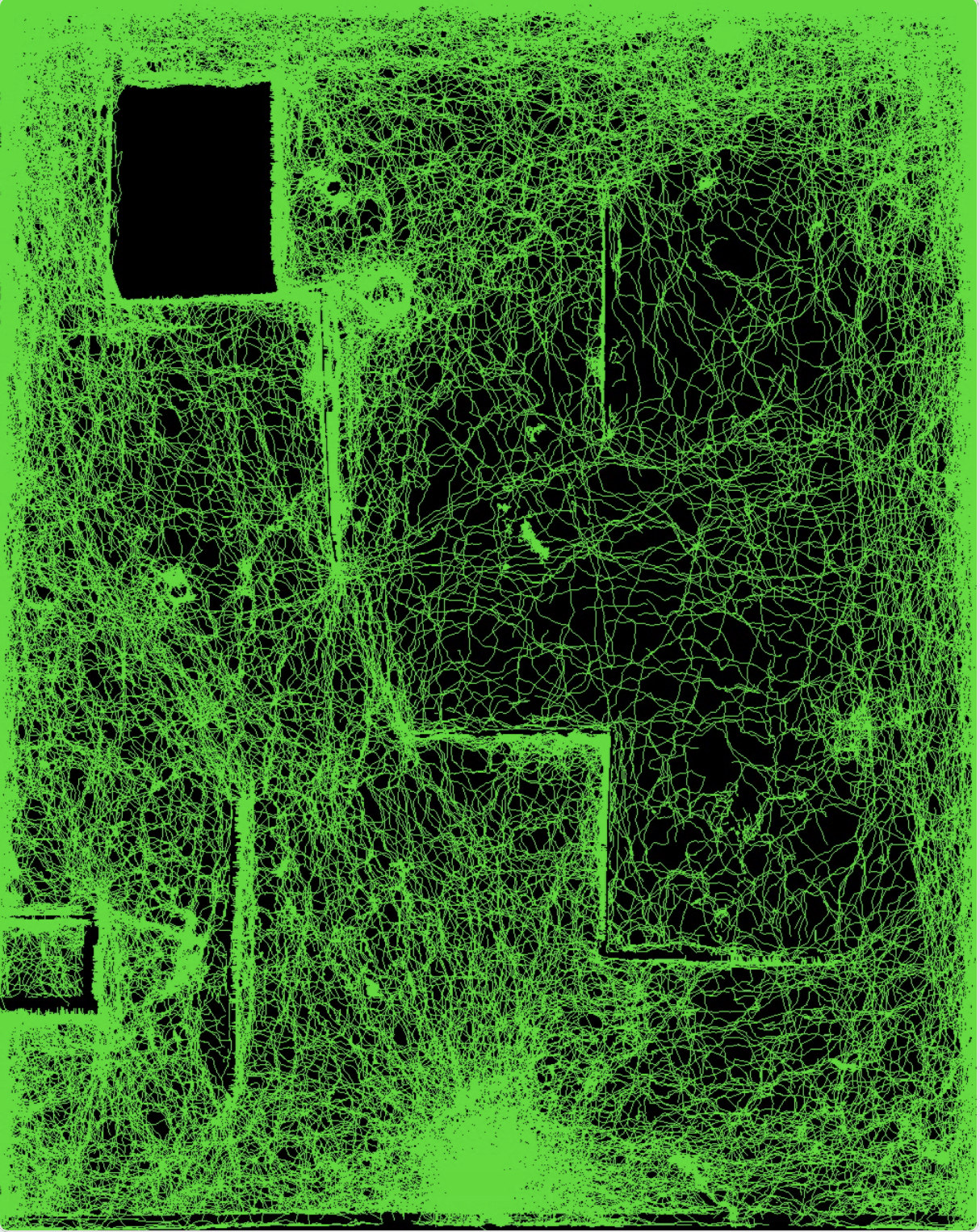
Our Messor aegyptiacus colony explored a labyrinth of plexiglass walls and seed piles in the sandbox. We tracked their movement over three days. Paths followed boundaries and gradually formed a dense web. The observations prompted questions about orientation and recruitment, without establishing the mechanisms behind the ants’ decisions.
Potato — foraging at human scale
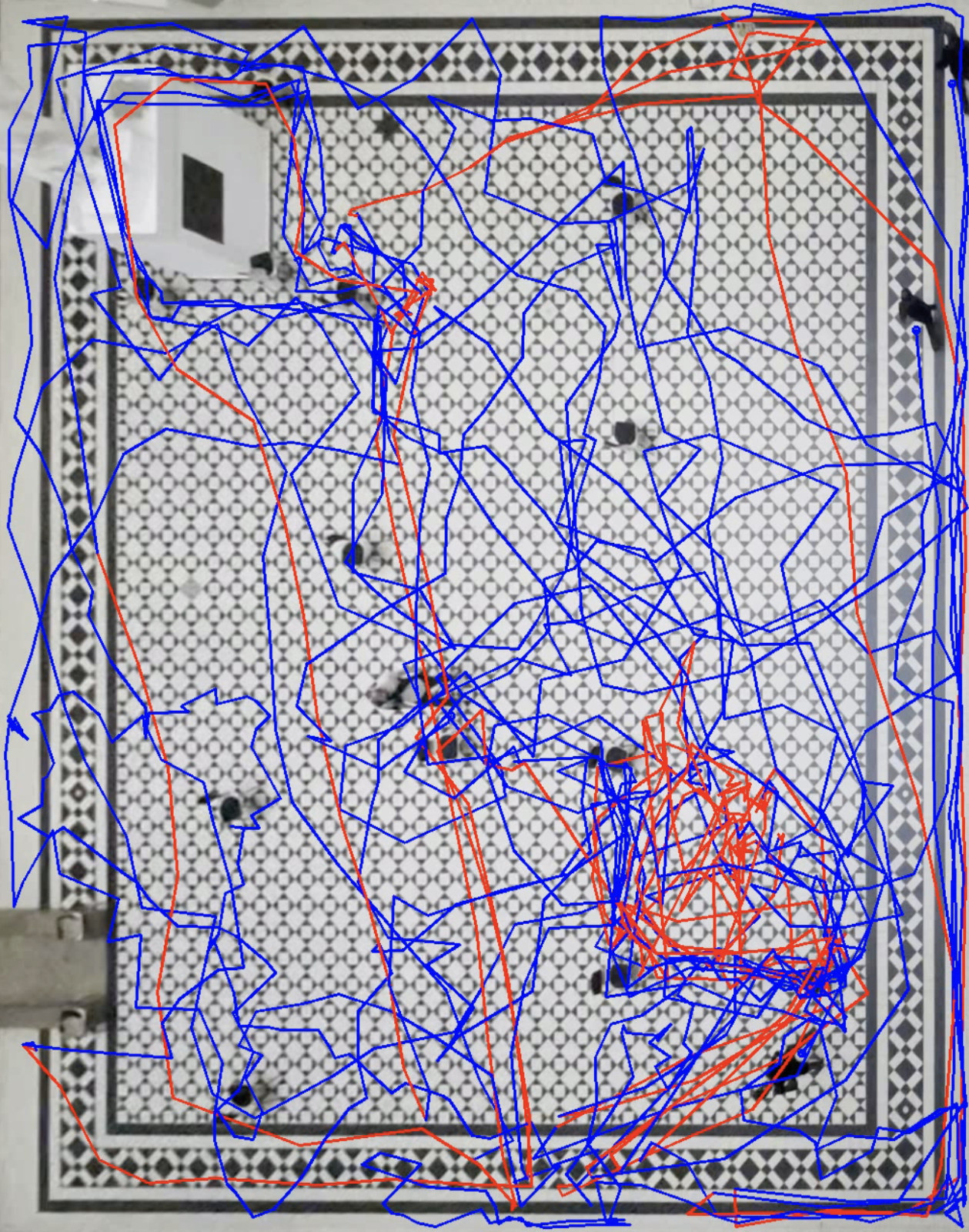
We recreated the layout at ten times the scale in TU Berlin’s 20 × 16 m Lichthof. Four blindfolded participants searched for potatoes during a 30-minute trial. They could communicate through touch but could not speak. A loudspeaker marked the nest, while ropes between chairs defined obstacles. Informal interviews suggested that encounters with other participants supported motivation and orientation.
Pixel — an algorithmic interpretation
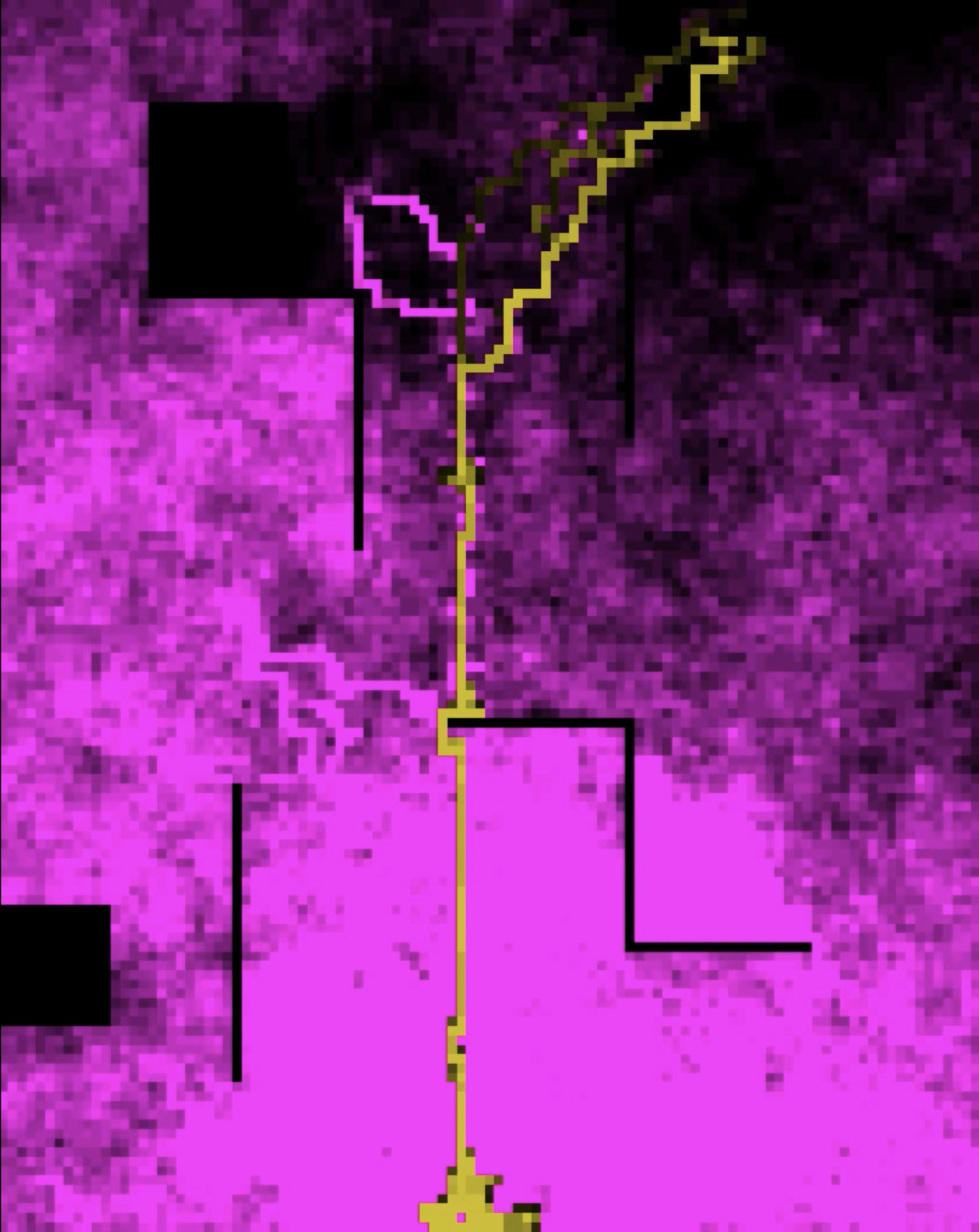
A custom implementation of Ant Colony Optimization, drawing on Dorigo and Di Caro (1999), placed four digital agents in a pixel-grid labyrinth. Weighted stochastic choices, visited-cell penalties, and evaporating pheromone values shaped exploration. Return navigation used an implementation of Dijkstra’s (1959) algorithm. The resulting behaviour depended strongly on the chosen rules and parameters; it was an interpretation of foraging rather than a faithful biological model.
Findings, limitations, and future directions
The comparison revealed different uses of the same obstacles. Ants often followed their edges, humans tried to form mental images of the layout, and digital agents explored according to programmed weights. One zigzag obstacle caused difficulty for all three groups, but for different reasons. Encounters between living participants also mattered: humans described renewed motivation, while ant interactions were associated with cooperative seed transport.
These are qualitative observations. The study did not establish a quantitative ranking of intelligence or foraging success. Potato ran once with four participants, the tracking was not performed under controlled laboratory conditions, and path traces cannot reveal an organism’s inner experience. Ants forage to survive, humans knowingly participate in a game, and digital agents operate within code; a shared visualisation does not erase these differences.
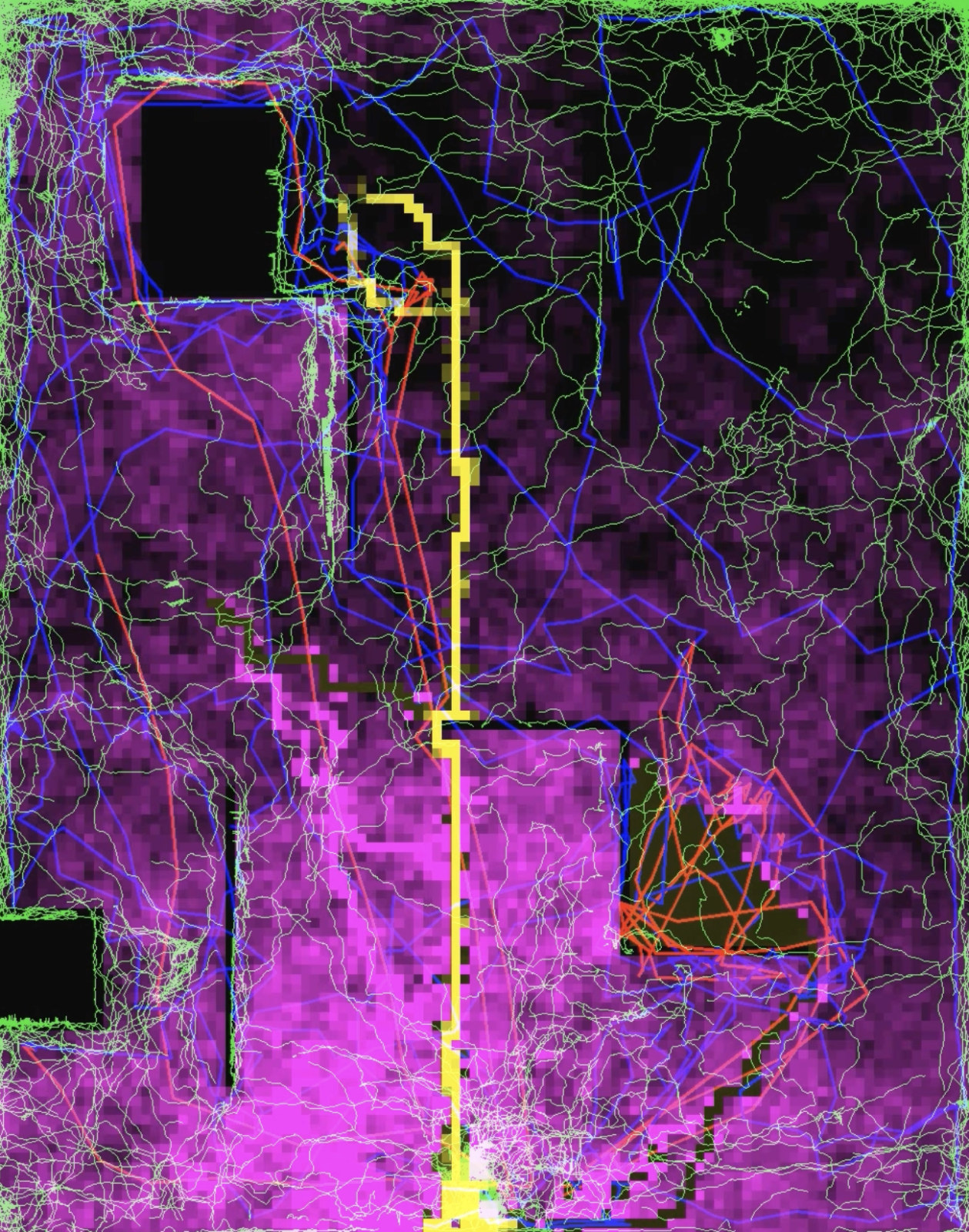
The work’s central contribution is a practical interface for observing and discussing relationships across species and scales. Its ethical tensions remain visible: a larger habitat still confines the ants, camera tracking creates an unequal relationship of observation, and simulation cannot remove human assumptions. Future work could test less restrictive habitats, alternative sensing methods, and longer-term activity monitoring, while treating care as part of the method.
References
Dijkstra, E. W. (1959). A note on two problems in connexion with graphs. Numerische Mathematik, 1(1), 269–271. https://doi.org/10.1007/BF01386390
Dorigo, M., & Di Caro, G. (1999). Ant colony optimization: A new meta-heuristic. In Proceedings of the 1999 Congress on Evolutionary Computation—CEC99 (S. 1470–1477). IEEE. https://doi.org/10.1109/CEC.1999.782657
Dreyer, T., Haluts, A., Korman, A., Gov, N., Fonio, E., & Feinerman, O. (2025). Comparing cooperative geometric puzzle solving in ants versus humans. Proceedings of the National Academy of Sciences, 122(1), e2414274121. https://doi.org/10.1073/pnas.2414274121
Ellison, A. M., & Gotelli, N. J. (2021). Ants (Hymenoptera: Formicidae) and humans: From inspiration and metaphor to 21st-century symbiont. Myrmecological News, 31, 225–240. https://doi.org/10.25849/MYRMECOL.NEWS_031:225
Gordon, D. M. (2023). The ecology of collective behavior. Princeton University Press. https://doi.org/10.1515/9780691232164
Haraway, D. J. (2016). Staying with the trouble: Making kin in the Chthulucene. Duke University Press. https://doi.org/10.1215/9780822373780
Keeling, D. M. (2017). Feral rhetoric: Common sense animals and metaphorical beasts. Rhetoric Society Quarterly, 47(3), 229–237. https://doi.org/10.1080/02773945.2017.1309905
Mac-Nelly, A., Kurth, L.-C., Baraitser Smith, M., & Rosenberg, M. Z. (2025). Ants x Interspecies Research Cluster. https://doi.org/10.13140/RG.2.2.32806.23363
Noda, C., Fernández, J., Pérez-Penichet, C., & Altshuler, E. (2006). Measuring activity in ant colonies. Review of Scientific Instruments, 77(12), 126102. https://doi.org/10.1063/1.2400215
O’Fallon, S., Drager, K., Zhao, A., Suarez, A., & Pinter-Wollman, N. (2023). Foraging behaviour affects nest architecture in a cross-species comparison of ant nests. Philosophical Transactions of the Royal Society B: Biological Sciences, 378(1884), 20220146. https://doi.org/10.1098/rstb.2022.0146
Shannon, C. E. (1948). A mathematical theory of communication. Bell System Technical Journal, 27(3), 379–423. https://doi.org/10.1002/j.1538-7305.1948.tb01338.x
Sleigh, C. (2001). Empire of the ants: H. G. Wells and tropical entomology. Science as Culture, 10(1), 33–71. https://doi.org/10.1080/09505430020025492
Relationships
- Related to grANT canyon
- Exhibited at Ars Electronica Festival 2025
- Related to Ants x Interspecies Research Cluster
- Related to Artificial ants and ethical entanglements
- Related to Seed. Potato. Pixel.